2026年8月27日

99% of aluminum folding doors on the market use a top-hung suspension structure. The entire weight of the door relies on the top track and those few hinges to hang there. The bottom track only acts as a guide; it doesn’t bear any load. This means that from the day it’s installed, all that weight is constantly applied to those few connection points. And the truth is, when designing this load-bearing system, most manufacturers simply didn’t calculate for a lifespan of more than three years.
A heavy-duty door leaf with double-glazed laminated glass can easily weigh as much as an adult man. For the sake of strength, the load-bearing hinges and screws must be made of 304 or 316 stainless steel. What about the door frame profile? It’s 6063-T5. Sure, it’s considered hard among aluminum alloys, but up against stainless steel, it’s still soft.
With opening and closing every day, the massive pressure generated by hundreds of kilograms is entirely concentrated on those few stainless steel screws. The screws repeatedly grind inside the aluminum screw holes. The result? The threads on the aluminum are ground away bit by bit. Once the screws can no longer grip, they slip, and in that instant, the door panel sags. If you go look at those failing doors, the aluminum itself isn’t broken—the screw holes have just been hollowed out. This is a textbook example of stripped screws in aluminum door frames leading to complete heavy duty aluminum folding door hardware failure. If you want to know how to prevent folding doors from dropping, you have to look at the internal structure.
Even if the aluminum folding door’s thickness reaches 2.0mm, it’s still not enough to fully anchor the screws. If the inside of the profile is just one big empty cavity, when you drive your load-bearing screws in, the only part truly taking the force is that 2.0mm outer skin. With door panels weighing hundreds of kilograms pulling and shaking every day, relying on this single layer of skin means that once metal fatigue sets in, slipping or tearing is just a matter of time. For the real stress points, the inside of the profile must have independent, thickened fastening cavities, allowing the screws to bite deeply into multiple layers of structure, rather than just hanging onto a single skin.
The final result often depends entirely on the installer’s skill level.
Summary in one sentence: Whether a folding door sags or not is largely destined from the day the profile mold and structural design are finalized. The rest is entirely up to the hands-on skills of the installer.
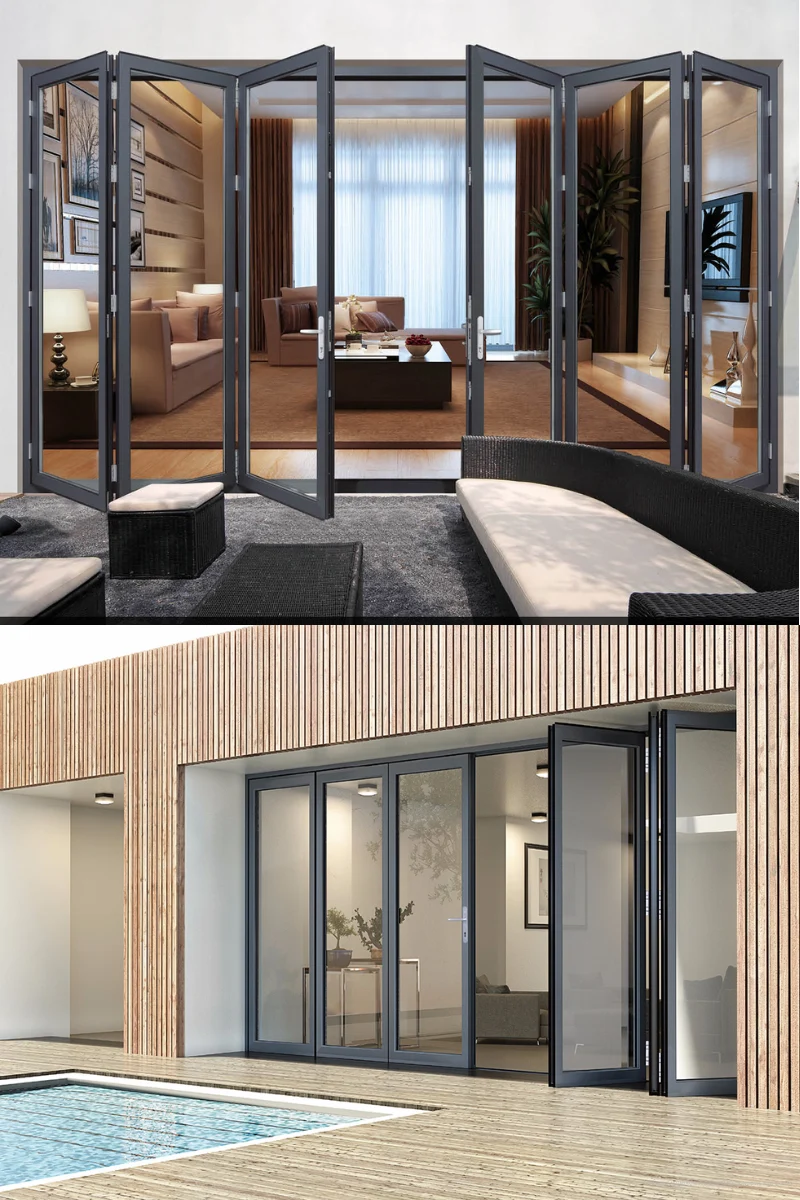
For folding doors, we at Shenghai Aluminum Group use 100% pure virgin 6063-T5 aluminum alloy. This is the mainstream aluminum alloy grade for aluminum doors and windows, combining cost-effectiveness, strength, and chemical stability.
When looking at 6063-T5 vs other aluminum alloys for doors, you must understand that to ensure the folding door profile can be extruded into complex multi-cavity sections while maintaining reliable tensile strength, both indoor and outdoor aluminum folding doors must strictly use 6063-T5 virgin aluminum ingots. You must avoid mixing in recycled scrap aluminum. Otherwise, due to uneven hardness and a brittle texture, hidden fractures can easily occur when the frame is subjected to the massive shear forces of suspended door panels.
The thermal break strip of a folding door doesn’t just need to block temperature; it must also possess structural stability. The thermal insulation layer inside the aluminum profile is a thermal break PA66 GF25 aluminum extrusion (Nylon 66 containing 25% fiberglass) multi-cavity strip.
Reason: Inferior PVC thermal break strips will soften and deform under the scorching summer sun, especially for our clients in the Middle East, like Saudi Arabia. If a “bimetallic effect” occurs between the indoor and outdoor aluminum (where the outside expands while the inside doesn’t), the entire door panel will suffer from a “bowing effect,” directly causing the door to jam in the track and making it impossible to slide. This is a notorious issue with thermal expansion in aluminum bifold doors. PA66 has an expansion coefficient very close to that of aluminum, which completely eliminates this phenomenon.
A standard window wall thickness of 1.2mm is a total disaster for folding doors. People often ask about the minimum aluminum wall thickness for bifold doors—for heavy-duty folding doors, the main load-bearing wall thickness must reach 2.0mm, and the hardware stress points need localized thickening.
The consequences of insufficient thickness: Sagging is the number one killer of folding doors. If the whole frame only has a thin 2.0mm outer wall, the stainless steel hinge screws will quickly strip inside the aluminum. Excellent profile interiors must feature independent hardware fastening cavities with walls as thick as 3.0mm – 4.0mm, or built-in stainless steel backing plates.
Engineering Solution: Standard 2.0mm thickness cannot withstand the long-term stress of oversized door panels. As a source manufacturer, Shenghai Aluminum Group provides custom aluminum extrusion for heavy duty doors. We locally thicken key hardware stress points to 3.0mm-4.0mm and design independent fastening cavities, physically eradicating the after-sales risk of door sagging from the ground up.
The splicing gaps between folding door panels are the most numerous, presenting a massive watertightness challenge. We use EPDM (Ethylene Propylene Diene Monomer) foam and solid composite co-extruded sealing strips to tackle this.
An aluminum folding door equipped with basic UV, high-temperature, and salt spray resistance is already enough to satisfy most environments.
However, if you are looking for the best aluminum folding doors for extreme hot weather, standard finishes won’t cut it. For extreme regions—such as the scorching desert climates requiring high UV resistant folding doors for Middle East projects, or high salt-spray environments in South Africa—the aluminum folding door finishes must achieve Qualicoat Class 2 (seaside-grade highly weather-resistant powder coating) or feature an AAMA 2605 PVDF coating for coastal areas.