
2026年10月8日

Wall thickness refers to the actual metal thickness of the aluminum profile used in the frame, sash, and key structural components of an aluminum folding door system. In engineering practice, it is typically measured in millimeters, such as 1.4 mm, 1.8 mm, 2.0 mm, 2.5 mm, or 3.0 mm.
At Shenghai Aluminum Group, we always emphasize that wall thickness is not an isolated specification. It only becomes meaningful when it is evaluated together with the profile’s cross-sectional geometry, internal chamber design, and load-bearing path in a complete aluminum door system.
Even with the same thickness, different structures perform differently. A simple rectangular section and a multi-chamber reinforced profile can show completely different stiffness levels. This is especially important in high-performance architectural systems like folding glass doors.
—
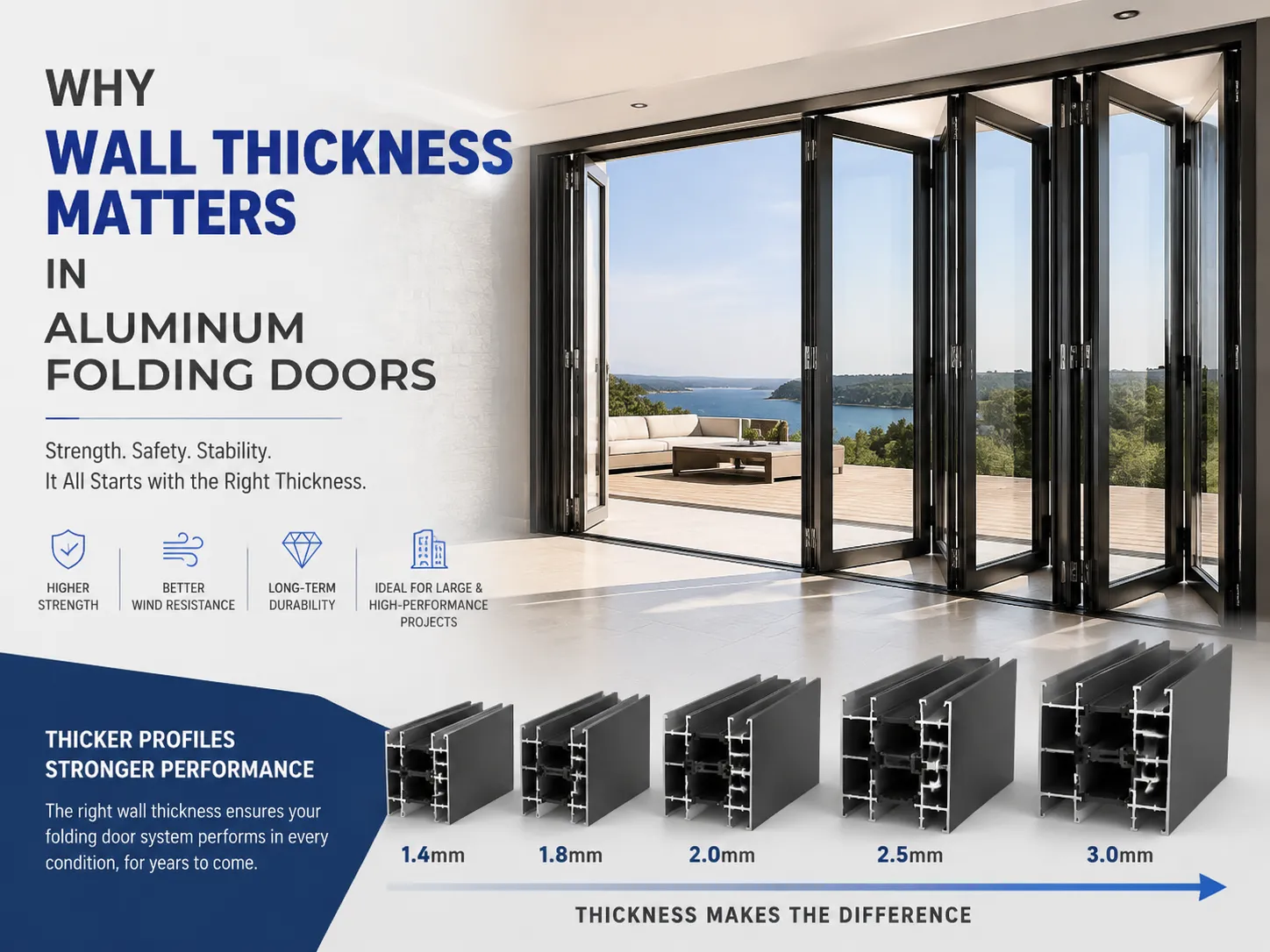
Wall thickness is not just a number on a datasheet. In bifold doors, it acts as a performance multiplier that defines how the entire system behaves in real conditions.
It directly affects two key structural safety factors:
Deflection and load capacity – how large and heavy each door leaf can be without sagging or deformation.
Wind pressure resistance – whether the system can maintain stability and sealing under extreme conditions.
This is why in a professional aluminum door manufacturer context, wall thickness is always evaluated together with system design, not in isolation.
—
A folding door system can be compared to a heavy book supported from one side. One edge is fixed by hinges, while the rest of the structure carries continuous load from glass weight and movement.
Wall thickness acts like the strength of the supporting hand. The thicker the profile, the higher the bending resistance, and the more stable the structure remains over time.
This becomes especially critical in large-scale folding glass doors. When door heights exceed 2.8 meters, insufficient wall thickness can lead to gradual sagging, misalignment, and poor closing performance.
In most cases, this is not a hardware failure but a limitation of the aluminum extrusion itself within the aluminum door system.
Repeated opening cycles also introduce fatigue stress. Over time, thin profiles may deform permanently, affecting long-term performance of bifold doors.
—
Wind load is not a single push—it is a continuous dynamic force acting on the entire aluminum folding doors structure.
When wall thickness is insufficient, the frame behaves like a flexible beam, showing visible deflection and vibration under pressure. When properly designed, the structure remains stable with controlled elastic recovery.
Thin-wall profiles are more likely to reach fatigue limits under repeated wind cycles. This can lead to deformation, misaligned locking points, and reduced sealing performance in folding door systems.
Vibration is another critical issue. It can gradually loosen screw connections and affect structural joints, especially in high-rise and coastal environments.
This is why for façade and coastal projects, engineers always prioritize wall thickness when selecting an aluminum door system from a reliable aluminum door manufacturer.
—
Wall thickness is only one part of the engineering system. It also affects hinge stability, frame integrity, and long-term performance of thermal break aluminum doors, especially in high-temperature environments.
It can even influence energy efficiency and structural behavior of advanced bifold doors used in modern architectural projects.
We will continue to expand on these technical factors in future discussions. For project-specific requirements involving aluminum folding doors or large-scale façade systems, proper engineering evaluation is always recommended before fabrication.