2026年10月8日

If you’re comparing aluminum glass bifold doors, you’ll quickly discover that most manufacturers focus on glass options, finishes and pricing.
The problem is that many long-term performance issues originate in the frame, hardware and installation system rather than the glass itself.
Most buyers spend three weeks comparing glass specs and ten minutes on the frame. That’s backwards. The frame is what fails.
Aluminum doesn’t warp. It handles thermal expansion without binding, and a well-built aluminum frame outlasts most of the buildings it’s installed in. Wood looks better in a brochure and worse after five years outside. uPVC is cheaper upfront — you’ll feel why the moment you touch it.
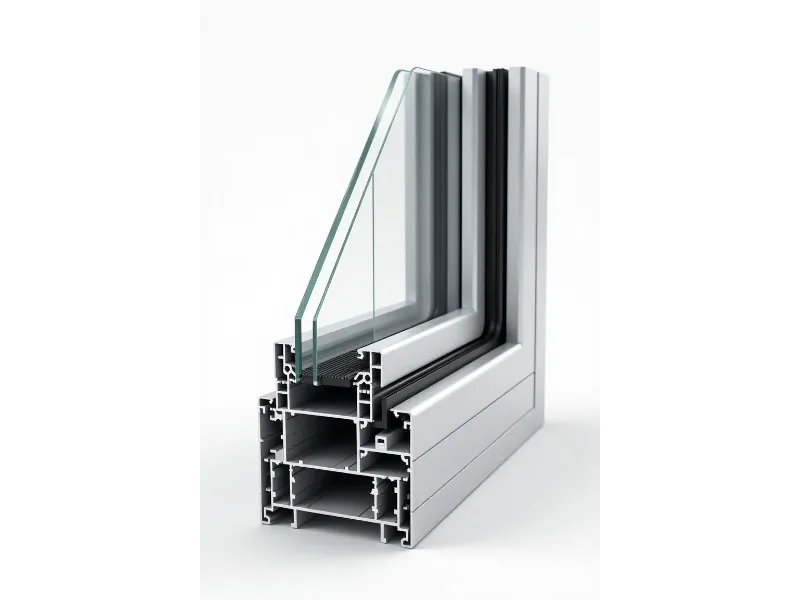
The real question isn’t aluminum versus something else. It’s which aluminum. Wall thickness and alloy quality vary widely across manufacturers, and for a door carrying multiple large glass panels that cycles open thousands of times, 1.8mm to 2.0mm wall thickness is the floor. Anything under that and you’re buying a door that performs well on day one and shows its compromises around year five.
Ask for the profile specification in writing. If a supplier can’t provide it, you have your answer.
Case:
A villa project in Dubai originally specified a bifold door system using 1.4mm aluminum profiles to reduce costs.
After reviewing panel dimensions and expected usage frequency, the specification was upgraded to a 2.0mm thermal break system.
The frame cost increased by less than 10%, but the upgraded system delivered better structural stability and reduced the risk of alignment issues over time.
Tempered glass isn’t optional on any exterior bifold. It’s a safety requirement in most building codes and a structural necessity given the panel sizes. If a listing doesn’t specify tempered, assume it isn’t.
Laminated glass holds together on impact instead of shattering — relevant for coastal, hurricane-rated, or high-security applications. It costs more. For standard residential use, tempered is enough; for everything else, laminated earns its premium.
Low-E coatings are where marketing gets loose. What matters is the Solar Heat Gain Coefficient and the U-value — not the brand name on the coating. An SHGC of 0.25 and a U-value of 1.4 W/m²·K is doing real work. A coating that improves those numbers by 5% over standard glass is mostly a line item.
Double glazing is standard. Triple glazing makes sense in cold climates — Canada, Scandinavia, high-altitude builds — but it adds real weight per panel. If the structure and hardware weren’t specified for it, don’t retrofit it.
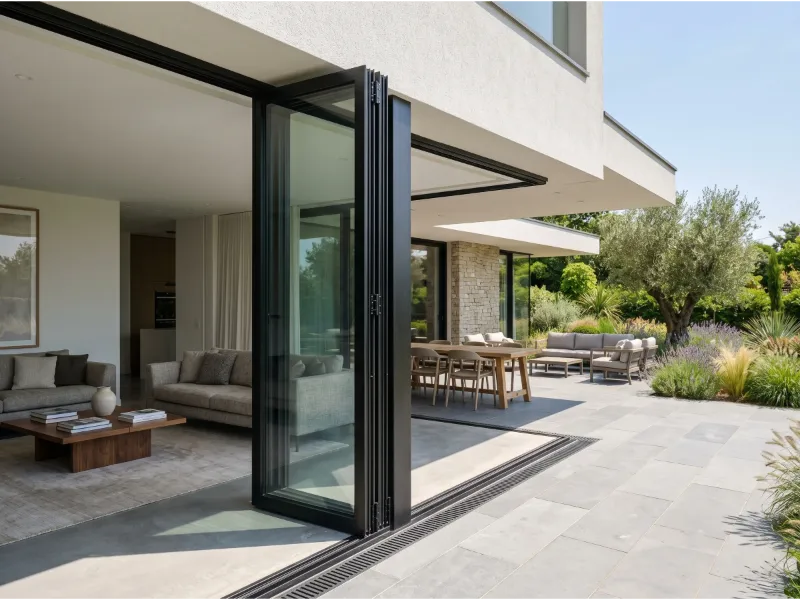
Panel count changes the math. Four panels on a 4.2m opening gives you a different usable clear width than six panels on the same opening, because every extra panel adds stacking depth at the fold side. More panels, more folding flexibility, less clear width when open.
For most residential applications, four panels up to 4.2m works. Beyond that, six panels or a split configuration.
Floor tracks versus trackless is the decision buyers underestimate most. Recessed tracks give stability and a clean line. Raised tracks are cheaper to install and a trip hazard. Trackless looks best, costs most, and needs a precisely level floor — which most existing floors aren’t. If you’re retrofitting, get the floor surveyed before specifying trackless. Leveling a floor mid-project costs more than the difference between track options ever would.
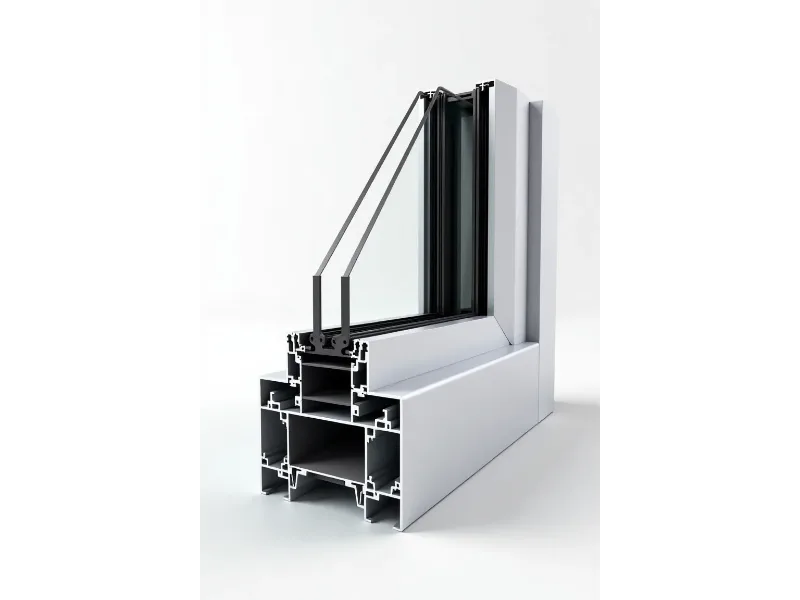
Whole-window U-value. Not center-of-glass, not frame-only — the whole-window figure, which accounts for the complete assembly.
A high-performance aluminum bifold door should clear 1.6 W/m²·K. Below 1.2 W/m²·K requires a thermal break profile and high-spec glazing. Above 2.0 W/m²·K and the door is actively adding to your heating or cooling bill.
Thermal break profiles are standard on anything claiming energy efficiency. The break is a PA66 GF25 polyamide strip separating the interior and exterior aluminum — without it, the frame conducts heat as fast as bare aluminum, which is very fast. Ask for the test report. A claimed specification without test data behind it isn’t a specification.
In the US, California Title-24 and ENERGY STAR are the practical benchmarks. In Europe, EN 14351-1. If your supplier isn’t familiar with either, that’s worth knowing before you order.
The difference between a $4,000 door and a $14,000 door is mostly in the hardware. That gap is usually justified.
| Feature | Standard System | Premium System |
|---|---|---|
| Frame Thickness | 1.4-1.6mm | 1.8-2.0mm |
| Thermal Break | Optional | Standard |
| Hardware Cycles | 20,000 | 50,000+ |
| Security | Single Point | Multi Point |
| Warranty | 3-5 Years | 10+ Years |
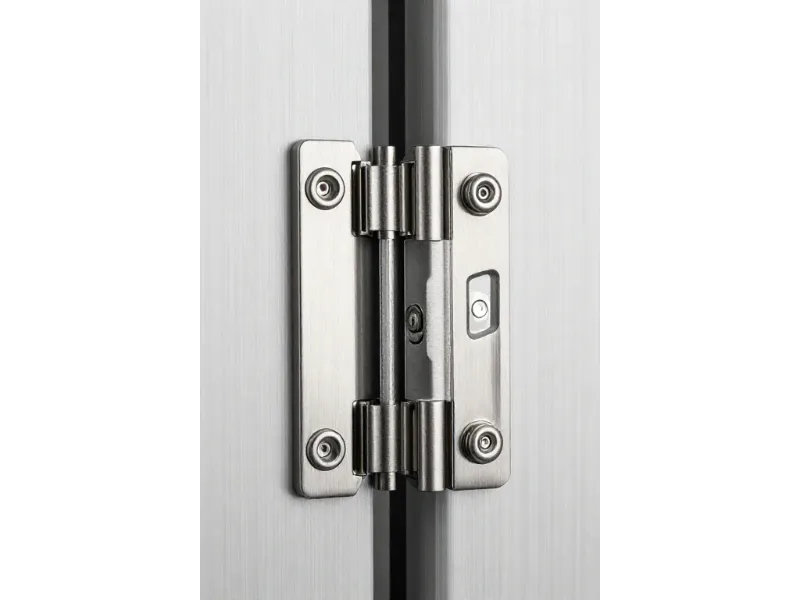
Bifold hinges carry more load than any other door type — panel weight, lateral stress, and the dynamic force of repeated folding. Quality hinges are stainless or marine-grade aluminum, adjustable in three axes, and rated for 50,000 cycles minimum. Budget hinges are none of those things, and you’ll know it by year two.
Multi-point locking is non-negotiable on any exterior application. A single-point lock leaves the inactive panels essentially unsecured. Multi-point systems engage at the top, bottom, and center of the active panel — meaningfully more resistant to forced entry, and better at holding weather seal under wind pressure.
Chrome handles on exterior doors look good on delivery. Eighteen months later, in most climates, they don’t. Flush pull handles in stainless or anodized aluminum hold their finish. Specify accordingly.
Stock works when your opening is standard: common widths (2.4m, 3.0m, 3.6m, 4.2m), standard heights (2.1m or 2.4m), no unusual configuration. If you’re in that bracket, a quality stock door saves six to ten weeks and a real cost premium.
Custom is necessary when the opening doesn’t fit, the finish isn’t available in stock, or the performance requirements exceed what standard products are certified to. For high-end residential and commercial projects, custom is usually the right call — not because stock is inadequate, but because the specification that justifies the budget typically exceeds what stock is built to deliver.
Lead times run four to ten weeks from confirmed order. Lock that in before you finalise the project schedule, not after.
Warranty terms reveal how much confidence a manufacturer has in what they’re selling. Ten years on frame and hardware is the baseline. Read the exclusions — warranties that cover the frame but not the hardware, or defects but not weathering performance, are narrower than they look.
Ask about replacement parts availability. Hinges wear. Seals degrade. Handles get damaged. If the manufacturer can’t confirm parts availability for the next 15 years, the door’s service life is tied to their business continuity, not yours.
Ask about the installer network. A correctly specified door fitted incorrectly performs like a poorly specified door. For large commercial installations, manufacturer-supervised installation isn’t optional.
If the price looks too good for the specification, something in that spec has been quietly substituted. You won’t see it on delivery.
You’ll see it at year three.