2026年8月27日

When choosing doors and windows, many people’s first instinct is to compare prices. That’s perfectly fine. But if you plan to use them for 30 years, focusing solely on the purchase price can be risky. We’ve completed numerous projects in the Middle East, Southeast Asia, and China’s coastal regions, and we’ve observed a common pattern: Many property owners and contractors only begin to regret their decisions 10 years down the line—not because they spent too much initially, but because they spent too little.
Three materials: UPVC, steel, and aluminum alloy. Each has its own lifespan. Without breaking down the costs, you have no idea how much money you’ll end up pouring into them later.
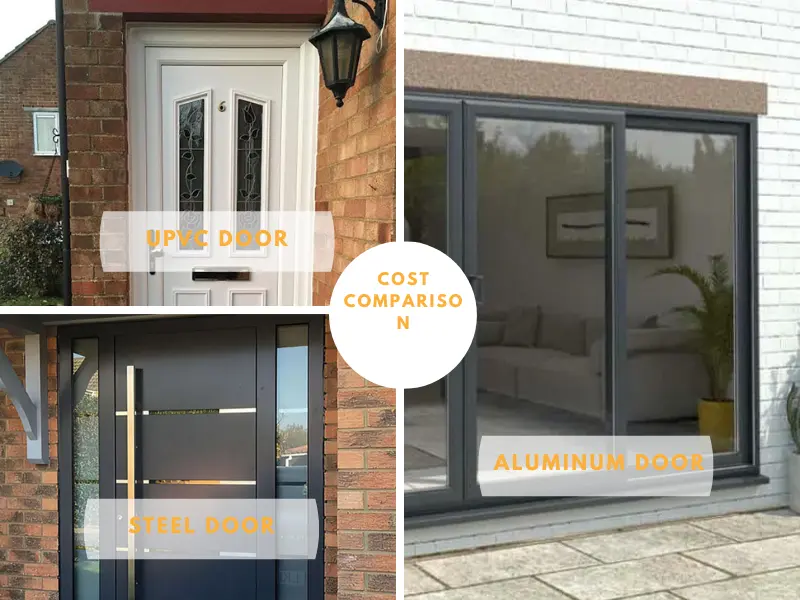
The initial price of UPVC is indeed low. The raw materials are inexpensive, and the manufacturing process is straightforward—just add a steel liner and install the hardware, and it’s ready to ship. If you’re working on a short-term project, such as renting a property for seven or eight years, then it’s worth considering. But for owner-occupied homes or long-term holdings, you need to carefully consider the following costs.
The problem with UPVC isn’t the plastic itself, but the fact that it relies on a steel liner to function. Plastic lacks sufficient strength; without a steel liner, the frame will rattle in the wind. But once the steel liner is installed inside the door or window, it creates a hidden hazard: the protective coating is damaged during cutting and drilling. In coastal areas with high salt fog, if the drainage holes become blocked, the steel liner is left soaking in saltwater. As the rust expands, it forces the plastic frame to crack from the inside.
There is a real-life case in Sanya, Hainan. A homeowner installed a brand-name UPVC sliding door six years ago, and the seller promised a 20-year warranty. This year, however, the door frame suddenly bulged and collapsed at the slightest touch. Upon dismantling it, they found the steel liner had rotted into a mass of rust, expanding to the point of bursting the plastic frame. Rust-stained water had yellowed the wall, and the door could no longer be opened, forcing a complete tear-down. The cost for replacing the three doors and repairing the wall totaled 12,800 yuan. The homeowner remarked, “If we’d waited another six months, the door might have fallen off on its own.”
Moreover, the manufacturer’s warranty does not cover rusting of the steel lining. In areas with heavier salt spray, such as the Persian Gulf, this problem can arise within just three or four years.
Shipping costs are also a concern. Although UPVC is lightweight, if trade terms (FOB, CIF, DDP) aren’t clearly specified in advance during export, port charges at the destination may end up costing more than the doors themselves.
The advantages of steel doors are straightforward: they’re sturdy. Fire-resistant, burglar-proof, and impact-resistant, they’re essential for prisons, vaults, and industrial equipment rooms. But for a typical seaside villa, a steel door isn’t a hassle-free choice.
The biggest cost with steel doors is rust prevention. Once the coating is scratched, rust begins to spread from that point. We’ve seen too many examples: a small chip in the paint during installation leads to a large rust spot two years later. You’ll need to inspect and touch up the paint every two to three years. In high-salt-fog areas like Bahrain or Jeddah, the door will be ruined within a few years if not maintained. The labor and material costs for touch-ups, plus lost productivity, may end up costing more than the door itself.
The door is too heavy, and the hardware can’t handle it. Steel doors weigh 2–3 times as much as aluminum doors. Hinges, floor springs, and door closers are subjected to constant heavy loads, causing them to wear out extremely quickly. The cost of replacing a single door closer is several times that of a standard hinge. Just calculate how many times you’ll need to replace them over 30 years.
Shipping costs for steel doors are also high when exported, as they’re charged by the ton. Loading and unloading require machinery, adding another layer of costs for crane services.
Many people think aluminum alloy is expensive. But the extra cost is largely invested in features designed to “save you trouble down the road.”
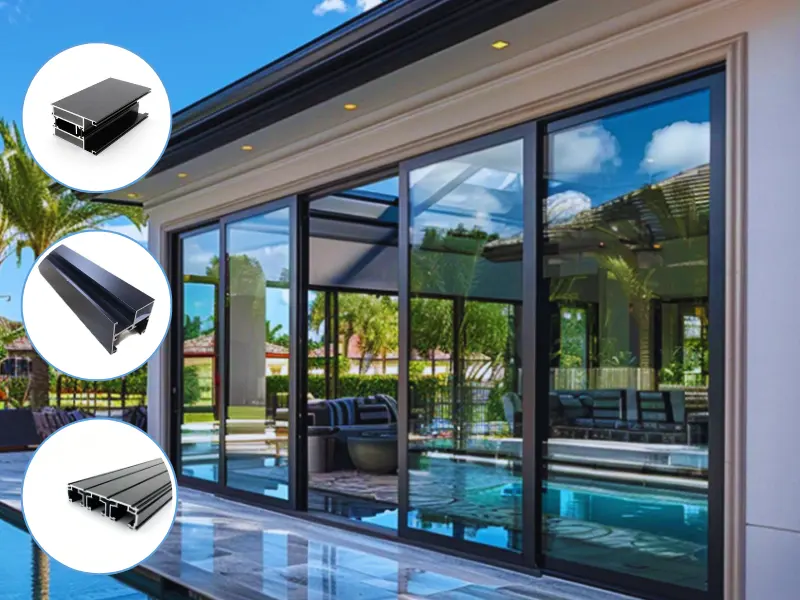
While the cost of aluminum ingots is indeed high, 6063-T5/T6 is an industry-recognized grade known for its stability and reliability. Our Foshan factory specializes in extrusion; while processing fees for complex cross-sections (thermal breaks, multi-chamber profiles) may be slightly higher, Foshan’s mature industrial cluster ensures price transparency. Experienced factories (like ours) can provide reasonable quotes while maintaining quality.
Surface treatment determines longevity—it’s not something you can skimp on. Powder coating offers excellent value for money; polyester is sufficient for standard regions. However, if your project is in a high-temperature, high-salt-fog, and strong UV environment like the Persian Gulf, you’ll need Qualicoat Class 2/Class 3, or even AA25 anodizing or fluorocarbon coating. When working on Middle Eastern projects, we rarely recommend lower-grade coatings, as they will fade and chalk within a few years—and the client will blame you.
Thermal break spacers must be made of PA66; PVC is not acceptable. Many low-cost products use PVC spacers as a substitute, but we’ve seen firsthand on projects in Saudi Arabia and South Africa that PVC spacers age and become brittle within a few years in high temperatures, rendering their thermal insulation performance useless. It’s not worth cutting corners on this.
Hardware must also be upgraded. For coastal projects, we exclusively use SS316 stainless steel. It’s a bit more expensive, but it won’t rust and seize up after a few years like 304 does.
Maintenance is virtually nonexistent. Just wipe them down with a neutral cleaner once a year; in coastal areas, rinse the window frames with clean water every quarter to remove salt buildup. Apply a little lubricant to the hardware every two years, and replace the weatherstripping every eight years. You can handle these tasks yourself—it costs next to nothing.
Most importantly, you won’t need to replace them. Take an older project in Laoshan, Qingdao: aluminum alloy doors and windows installed in 1993. By 2025, they’ll have been in place for 32 years, just 500 meters from the sea. They still open and close smoothly; the door frames show no warping, bulging, or rust. Only the handles have been replaced twice. The PVC-steel doors installed next door around the same time have already been replaced twice.
You can even make money from recycling them. After 30 years, the scrap aluminum price is still around 70% of the original aluminum ingot price. For a $1,000 door, the scrap value can recoup $300–$400. Steel and UPVC are basically worth scrap metal prices or have negative value.
| Material | Resale Value after 30 Years |
|---|---|
| UPVC | Extremely Low (Negative) |
| Steel | Low (Scrap Metal Price) |
| Aluminum Alloy | High (30–40% of Original Price) |
If you plan to live there for 10 years or less, or if your budget is extremely tight, UPVC might suffice. But if you want windows and doors that are hassle-free, retain their value, and don’t require constant repairs, choose aluminum alloy. It isn’t the cheapest option, but it will definitely have the lowest total cost over 30 years.
Many coastal projects have realized after a decade or so that: The real cost isn’t the purchase price, but the cumulative expenses from repeated repairs, replacements, decommissioning, and rework. Aluminum doors and windows allow you to settle the bill once and for all, requiring virtually no additional investment for the next 30 years.
Aluminum doors and windows aren’t the cheapest option, but they will definitely have the lowest total cost over 30 years.