
2026年8月27日

The thermal and acoustic performance of a window or door rarely depends on a single component.
Glass occupies a large part of the opening, so its specification matters. Aluminum profiles form the structural frame. Thermal Break systems, gaskets, spacers, hardware, and the installation joint all influence the final result as well.
In real projects, it is not unusual to see two window systems using the same type of double glazing and both described as Thermal Break Aluminum Windows, yet perform differently after installation. Indoor temperature stability, condensation around the glass edge, and noise reduction may not be the same.
The reason is often hidden inside the profile cross-section and the connection details.
For window and door manufacturers, architects, contractors, and purchasing teams, the more useful question is not simply whether a product is “thermally insulated” or “soundproof.”
The real question is:
Where does heat move through the system, and where can sound or air pass through it?
Traditional aluminum windows and doors offer high structural strength, good machinability, and considerable freedom in profile design.
But aluminum is also a relatively good thermal conductor.
When the interior and exterior aluminum sections are connected through a continuous metal path, heat can travel relatively easily from one side of the frame to the other.
In winter, outdoor cold can lower the temperature of interior-facing frame surfaces. In summer, heat from outside can move more readily toward the interior.
This is why the first step in thermal design is not simply making the aluminum wall thicker.
It is to control the conductive path between the exterior and interior sides of the frame.
This is one of the fundamental structural differences between a conventional aluminum window and a Thermal Break Aluminum Window.
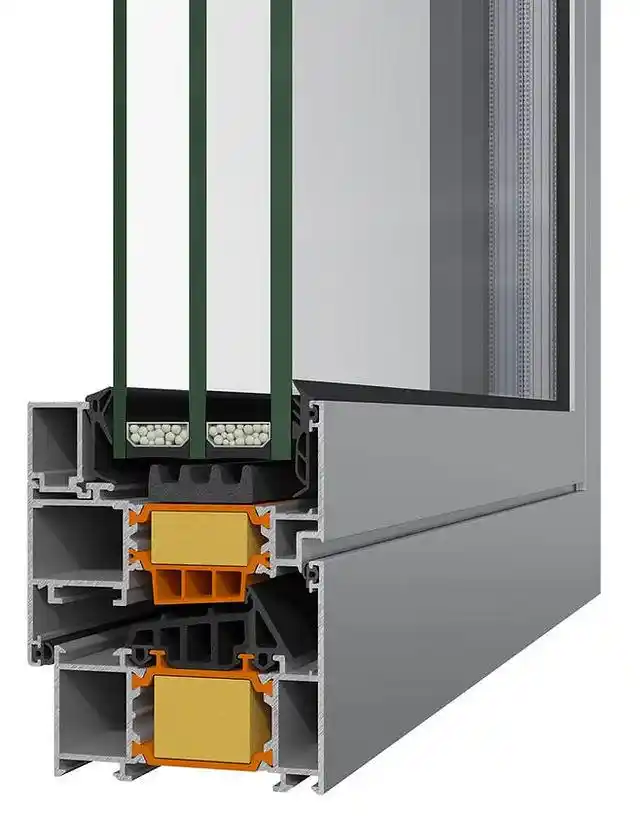
A Thermal Break is generally positioned between the interior and exterior aluminum sections.
Many systems use materials such as PA66 GF25 to separate the two aluminum components and reduce direct thermal conduction through the frame.
Conceptually, the original aluminum path is interrupted by a material with much lower thermal conductivity.
However, the actual engineering is more complicated than simply adding an insulation strip.
Two aluminum systems may both use Thermal Break technology while delivering different thermal results.
Important factors include:
This is why the statement “the profile has a Thermal Break” provides only limited information when evaluating a window system.
The Thermal Break is one part of the profile design, not the entire thermal solution.
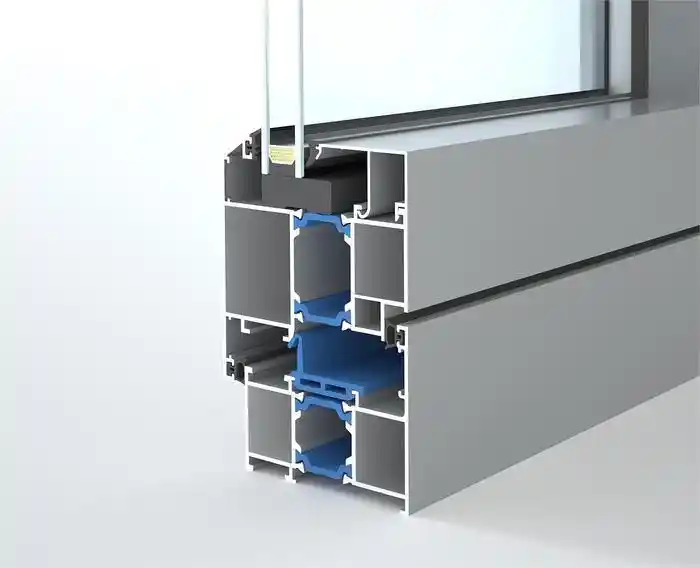
Heat does not necessarily travel through an aluminum profile in a simple straight line.
It tends to follow paths where thermal resistance is lower. As a result, almost every connection within the profile cross-section can influence thermal performance.
A well-designed Thermal Break Aluminum Profile should minimize continuous conductive connections between the interior and exterior aluminum sections.
However, localized metal components can create alternative heat paths.
These may include:
This is where Thermal Bridge analysis becomes important.
A profile may appear highly insulated when viewed as a simple cross-section, yet a particular connection can still create a localized area of increased heat transfer.
In cold climates, this can become visible through lower surface temperatures and, under suitable humidity conditions, condensation around the frame or glass edge.
A Thermal Bridge is an area within a building envelope where heat can move more easily than through the surrounding construction.
Common thermal bridge locations in aluminum windows and doors include:
These areas may receive little attention during basic product selection.
But when a project has demanding energy-efficiency or condensation-control requirements, they become much more important.
The glass edge is a particularly good example.
The center of an insulated glass unit may have strong thermal performance, while the edge temperature can be significantly different because of the Spacer, frame, sealant, and surrounding materials.
For this reason, evaluating a window only by the center-of-glass performance or the thermal properties of the aluminum profile does not provide a complete picture of the installed system.
Glass usually occupies most of the surface area of a window, making its specification highly influential.
Common configurations include:
Different glass configurations affect thermal transfer, solar heat gain, and sound transmission.
But once the glass is installed into the aluminum frame, it becomes part of a larger assembly.
The edge connection involves a sequence such as:
Glass Edge → Spacer → Gasket → Frame
Every part of this interface can influence the final result.
An unsuitable glazing pocket, inconsistent gasket compression, or poorly designed glass support can reduce the benefit of an otherwise high-performance glazing unit.
The Spacer also deserves attention.
A conventional Spacer and a Warm-Edge Spacer do not behave identically at the glass perimeter. In buildings where energy efficiency and condensation resistance are important, the glass edge should not be treated as a minor detail.
A window is not a completely solid barrier.
Air can move through gaps around opening sashes, between frame and sash components, through gasket interfaces, around hardware, or through the installation joint.
If the window remains partially leaky after closing, uncontrolled air exchange can occur between the interior and exterior.
For air-conditioned or heated buildings, this can increase energy losses.
For acoustic performance, the problem is even more straightforward.
Sound can also travel through gaps.
This explains why a window may use high-performance acoustic glass but still deliver disappointing noise reduction after installation.
The problem may not be the glass.
It may be the sealing system.
For this reason, Air Tightness should not be treated only as an energy-efficiency parameter. It also has a direct relationship with indoor comfort and Acoustic Performance.
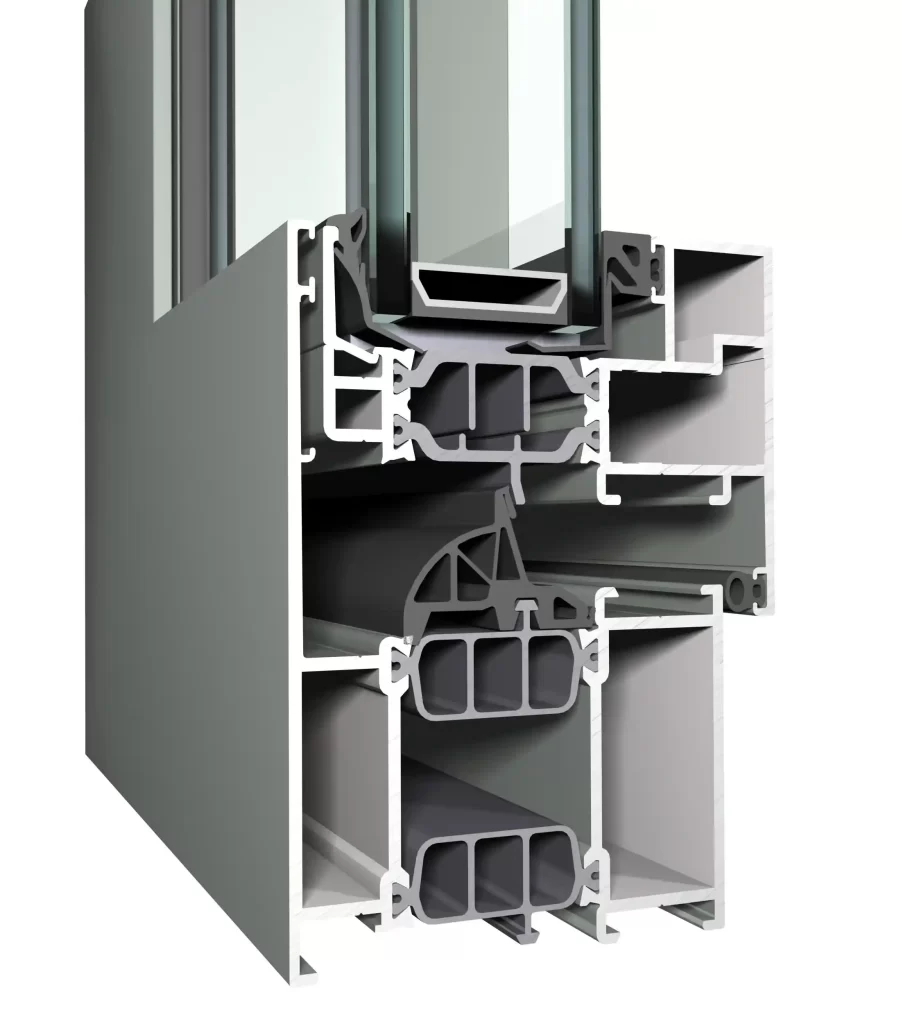
Increasing glass thickness can improve acoustic performance, but it is only one part of the design.
Other factors include:
There is another factor that is often overlooked:
Not all noise has the same frequency characteristics.
Traffic noise from a highway, voices around a hotel, industrial machinery, and aircraft noise can have very different frequency distributions.
A window optimized for one noise environment should therefore not automatically be assumed to provide the same level of control against every other type of noise.
For projects with demanding acoustic requirements, identifying the dominant noise source should come before selecting the glass and window configuration.
Consider a window using Acoustic Laminated Glass with strong acoustic properties.
If the gaskets around the sash do not maintain sufficient compression, however, sound can still pass through the resulting air path.
The same problem can occur if the frame-to-wall joint has been poorly sealed.
This leads to a practical principle in acoustic window design:
The overall system does not perform according to its best component. It is often limited by its weakest path.
A proper acoustic evaluation should therefore consider:
Glass + Frame + Gasket + Air Tightness + Installation
rather than simply comparing glass thickness.
Thermal insulation and acoustic insulation are different engineering properties and should not be treated as interchangeable.
However, several aspects of window design can influence both.
The sealing system is a good example.
Better sealing reduces uncontrolled air leakage while also reducing the paths through which airborne sound can enter a building.
Profile chambers can also influence both areas. Multiple chambers alter the path through which heat travels through the frame and can affect the acoustic behavior of the profile assembly.
The primary purpose of a Thermal Break is to reduce heat transfer through the aluminum frame.
But the overall profile geometry, chamber configuration, sealing system, and glazing combination also contribute to the system’s acoustic behavior.
For this reason, Thermal Performance, Acoustic Performance, and Air Tightness should not always be evaluated as completely separate design problems.
Condensation occurs when water vapor in the indoor air reaches a surface temperature below the relevant dew-point condition.
On windows and doors, condensation may appear on:
The glass edge and aluminum frame deserve particular attention because their surface temperatures can be affected by the frame geometry, Spacer, Thermal Break, and local thermal bridges.
Condensation does not automatically mean that the glass itself is defective.
Indoor relative humidity, outdoor temperature, surface temperature, and the thermal design of the entire window system all play a role.
For example, a window may show no visible condensation under a relatively dry indoor environment but develop condensation when indoor humidity increases and outdoor temperatures fall.
This is why buildings in cold climates, as well as buildings with relatively high indoor humidity, often require closer attention to Condensation Resistance.

When a window system increases in size—from a residential window to a floor-to-ceiling window, large Sliding Door, or commercial façade system—the engineering requirements change.
Glass weight increases.
Profile spans become longer.
Hardware loads increase.
At the same time, designers may need to evaluate:
This is why a standard window profile cannot simply be scaled up for a large opening.
As dimensions increase, structural and operational limitations become increasingly important.
For example, a large Sliding Door may have acceptable thermal performance but still experience difficult operation, sash drop, or reduced sealing performance if the profile strength and hardware capacity are insufficient.

This is one of the areas most often overlooked in product descriptions.
After a window or door arrives at the construction site, it still has to be connected to the surrounding wall assembly.
This interface may involve:
A well-designed window can still perform differently from its laboratory result if the installation joint is poorly executed.
For high-performance building envelopes, the frame-to-wall connection should not be understood simply as “filling the gap.”
The installation needs to maintain appropriate continuity between the interior air barrier, insulation layer, exterior water-management layer, and drainage path.
In other words:
The Window-to-Wall Interface becomes part of the building envelope once the window is installed.
When discussing products with suppliers, buyers often encounter descriptions such as:
Thermal Break Aluminum Profile
Energy Efficient
Soundproof
High Performance
There is nothing inherently wrong with these descriptions, but they provide limited engineering information.
For an actual project, buyers should ask for measurable data and specific construction details.
| Item | Information to Confirm |
|---|---|
| Aluminum Profile | Alloy, Profile Depth, Wall Thickness, Section Design |
| Thermal Break | Material, Width, Position, Configuration |
| Glazing | Glass Type, Thickness, IGU Configuration |
| Spacer | Spacer Type, Glass Edge Design |
| Gasket | Number, Position, Compression |
| Air Tightness | Test Result / Classification |
| Water Tightness | Test Pressure / Classification |
| Wind Resistance | Design Pressure / Test Result |
| Thermal Performance | U-value / U-factor |
| Acoustic Performance | Tested Acoustic Rating |
| Hardware | Load Capacity, Durability |
| Installation | Fixing, Insulation, Air Sealing, Waterproofing |
If a supplier provides only a profile cross-section and a statement such as “excellent thermal insulation,” there is not enough information to properly evaluate the performance of the complete window system.
There is no single window configuration that is ideal for every project.
For a residence beside a busy road, acoustic performance may be more important than achieving the lowest possible U-value.
For a home in a cold climate, the priority may be:
Thermal Performance + Condensation Resistance
For a high-rise commercial building:
Wind Load + Glazing + Thermal Performance + Air Tightness
For a hot climate:
Solar Heat Gain + Glazing + Thermal Break + Air Leakage
For a coastal project:
Salt Exposure + Corrosion Resistance + Surface Finish + Hardware Durability
This is why window selection should start with the building environment and project requirements rather than with a particular aluminum profile.
For engineering procurement and project design, the selection process can be approached in the following order.
Determine:
Establish the target requirements for:
Only at this stage should you compare:
Do not rely solely on marketing parameters.
For a genuine engineering project, the test result, test conditions, applicable configuration, and scope of the tested system are all important.
A performance value without its test conditions can be difficult to interpret.
Finally, verify that the selected window profile can properly connect with the building’s wall construction, insulation layer, waterproofing system, and interior air-sealing layer.
This approach is generally more reliable than selecting a system simply because it has a thicker profile or thicker glass.
If a complete window is broken down into individual components, its final performance does not come from any single part.
It comes from how those parts work together.
Profile Geometry
→ How is the aluminum cross-section designed?
Thermal Break
→ How are the interior and exterior aluminum sections separated?
Glazing
→ What glass configuration is being used?
Spacer & Glass Edge
→ How is the perimeter of the glazing unit designed?
Gaskets
→ How is the frame-to-sash interface sealed?
Air Tightness
→ Are there uncontrolled air leakage paths?
Drainage
→ How is water entering the system managed and discharged?
Hardware
→ Can the opening sash maintain the required compression and alignment over time?
Installation Interface
→ How is the window connected to the surrounding wall?
None of these details is particularly complicated when considered separately.
The challenge is making them work together as one system.
Thermal insulation and acoustic insulation are not simply two marketing labels attached to a window.
Whether a window can reduce heat entering a building during summer, retain indoor heat during winter, control traffic noise, or resist condensation around the glass edge depends on the interaction between the aluminum profile, glazing, sealing system, hardware, and installation interface.
For Thermal Break Aluminum Windows, the insulation strip is only the starting point of the thermal design.
For Soundproof Windows, the glass is only one part of the acoustic solution.
The actual performance is determined by the complete path—from the profile cross-section and glass edge to the frame-and-sash sealing system and Window-to-Wall Interface.
When evaluating a window supplier, it is therefore more useful to ask:
How is the profile designed?
Where are the potential thermal bridges?
How is the glazing configured?
What is the tested air tightness of the complete system?
What are the actual thermal and acoustic test results?
And can these performance levels be maintained after installation?
These questions provide much more useful information than simply looking for labels such as “Energy Efficient” or “Soundproof.”