2026年8月27日

Aluminum alloy is highly thermally conductive, with a thermal conductivity as high as 160 W/m·K. Although aluminum alloy is an excellent material for modern architectural doors and windows, a primary drawback is its high thermal conductivity. Therefore, to reduce costs, a thermal break design is used to minimize heat transfer, thereby keeping interiors warm in winter and cool in summer and reducing energy consumption for air conditioning and heating.
For building owners, the consequences are tangible. In winter, heat escapes through the frame; in summer, outdoor heat conducts inward. The result is not only physical discomfort and a drafty sensation—HVAC loads increase significantly, condensation forms on door frames, wall paint peels, and mold can even grow. All of this can be traced back to a single engineering phenomenon: thermal bridges.
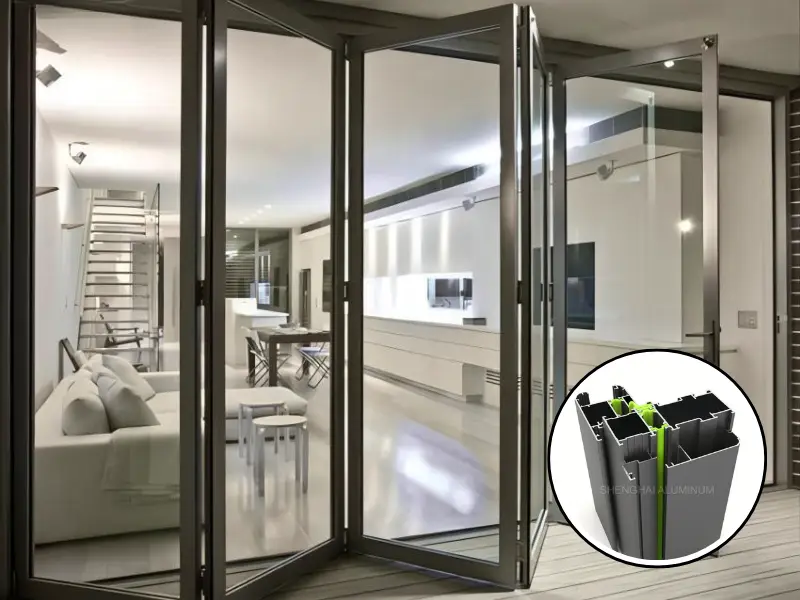
A thermal bridge refers to a pathway for heat transfer. When the thermal conductivity of the aluminum alloy in doors and windows is far higher than that of the glass and walls, the aluminum alloy becomes this pathway. It causes heat to escape from the interior in winter and to flow into the interior from the exterior in summer. Therefore, thermal breaks must be incorporated into the aluminum door and window frames to prevent this thermal bridge phenomenon.
To illustrate: Imagine a thick down jacket with a metal zipper running from the inside to the outside. In cold weather, the heat from your body would quickly escape along the zipper, and the inner surface of the zipper would feel painfully cold. This zipper is the “thermal bridge” in the garment.
Heat always spontaneously flows from areas of higher temperature to areas of lower temperature. The greater the temperature difference, the faster the heat transfer, and the greater the energy loss.
In non-thermally broken aluminum doors and windows:
In winter, there is a naturally occurring, uniform flow of heat within the interior walls and glass panels. When the aluminum alloy lacks a thermal break, this heat flow is drawn toward the highly thermally conductive aluminum alloy, causing it to rush toward the aluminum frame. Consequently, heat escapes rapidly through the aluminum alloy frame. This lowers the indoor temperature, significantly increasing the reliance on indoor heating.
The same principle applies in summer. Since outdoor temperatures are generally higher than indoor temperatures, heat flows from outside to inside, causing the indoor temperature to rise. This increases the use of air conditioning to lower the indoor temperature and maintain a comfortable environment for occupants.
In winter, the surface temperature at thermal bridge locations on window frames or interior walls is significantly lower than surrounding areas, often falling below the indoor air’s “dew point.” This results in moisture condensing into droplets. Prolonged dampness causes wall paint to bubble and peel, warps wooden floors, and—more seriously—fosters mold growth, directly affecting residents’ respiratory health.
In November 2024, residents of a Dubai waterfront villa using non-thermal-break aluminum windows experienced a massive temperature differential between year-round air conditioning and outdoor heat. The thermal bridges in the aluminum profiles caused persistent condensation on the window frames and massive mold growth in hidden areas. A family of four suffered from recurrent allergic rhinitis and persistent coughing, and their 3-year-old child was hospitalized due to repeated lung infections triggered by the mold. After replacing the windows with thermal break aluminum windows to eliminate the thermal bridge and completing mold removal, the family’s respiratory symptoms gradually subsided within three months and have not recurred.
First, high-precision inner and outer extruded aluminum profiles are required. These are extruded to create serrated grooves, facilitating the interlocking of the nylon strip.
Second, the nylon strip is inserted between the inner and outer aluminum profiles, where the serrated grooves on both sides initially grip the nylon strip.
Finally, using machinery from Shenghai Aluminum Group, the profiles and nylon strip are crimped together, ensuring the notches grip the nylon strip tightly.
Uninsulated aluminum alloy conducts heat rapidly. When a nylon strip is added, heat must pass through the nylon strip as it travels through the interior of the aluminum door frame. Since the thermal conductivity of the nylon strip is only a few hundredths of that of aluminum alloy, heat has a much harder time passing through it. Furthermore, some nylon strips, such as PA66, are not solid but feature a multi-chamber structure. Heat must travel through these additional pathways, further complicating heat transfer. Additionally, the chambers contain stationary air, which has a thermal conductivity even lower than that of the nylon strip itself, making heat transfer even more difficult.
Thermal break aluminum doors physically sever the high-speed pathway for heat conduction by inserting a low-thermal-conductivity, multi-chamber nylon strip between the inner and outer aluminum frames. This reduces energy loss through the frame by more than half, directly lowering HVAC electricity and gas expenses in both winter and summer. At the same time, it eliminates the hidden maintenance and health costs associated with condensation and mold, thereby achieving the goal of reducing energy costs.